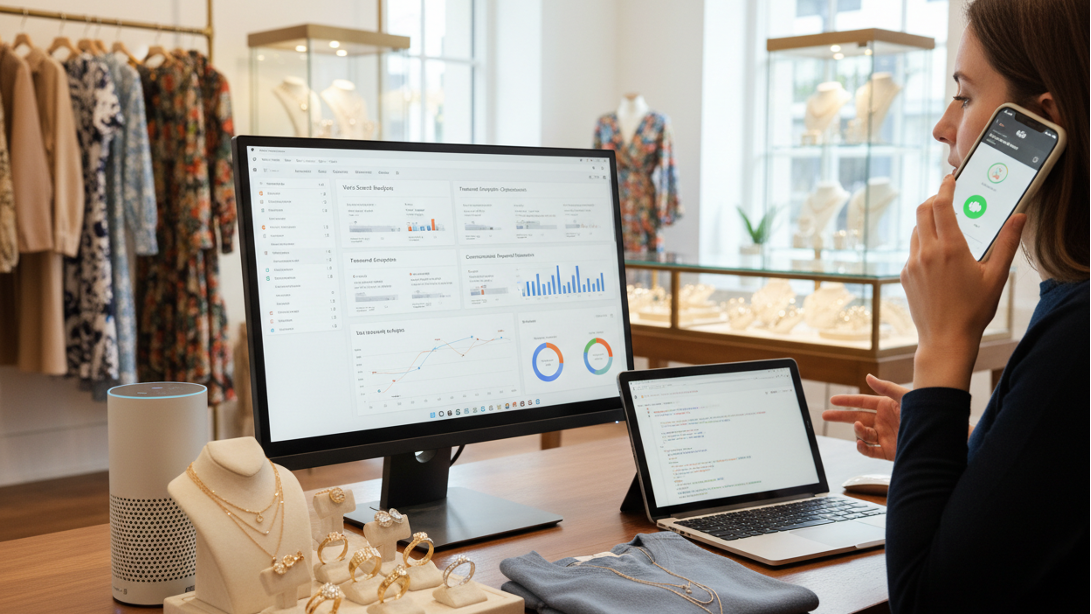

If you sell jewellery or clothing, you would have noticed how customers search today.
They do not type anymore. They talk.
They ask Google Assistant, Siri, Alexa, or voice search on their phones:
- Is there a diamond ring shop open now?”
- What is the best bridal boutique in Stellenbosch?”
- “Where can I find a bridesmaid dress wholesale store near me”
- “Where can I buy partywear on a budget?”
Voice search isn’t the future — it’s already here, quietly reshaping how local businesses get discovered.And for jewellery and clothing stores, voice search is a massive opportunity… because buyers with high purchase intent often use voice search first.
Let me show you how to optimise your boutique website for it, in a simple, practical, human-friendly way.

- You Must Understand How People Use Voice Search (It’s Very Different from Typing)
Typed search looks like: “bridal shop StellenboschVoice search sounds like: “Which store in Stellenbosch has good bridal collections?” or “Where can I find a collection of bridesmaid dresses near me?”
Voice search is:
- longer
- conversational
- question-based
- intent-driven
Your website SEO must match this natural speech pattern. Google matches your store to the voice query if your website sounds like your customer.
- Optimise for “Near Me” and Location-Based Searches
Voice search is heavily location-driven. Most jewellery and apparel queries are based on proximity.
People ask:
- “best gold shop near me”
- “designer jewellery, decorated clothing close to me”
- “ready-made blouse shop in Stellenbosch”
- “Bridal boutiques near me”
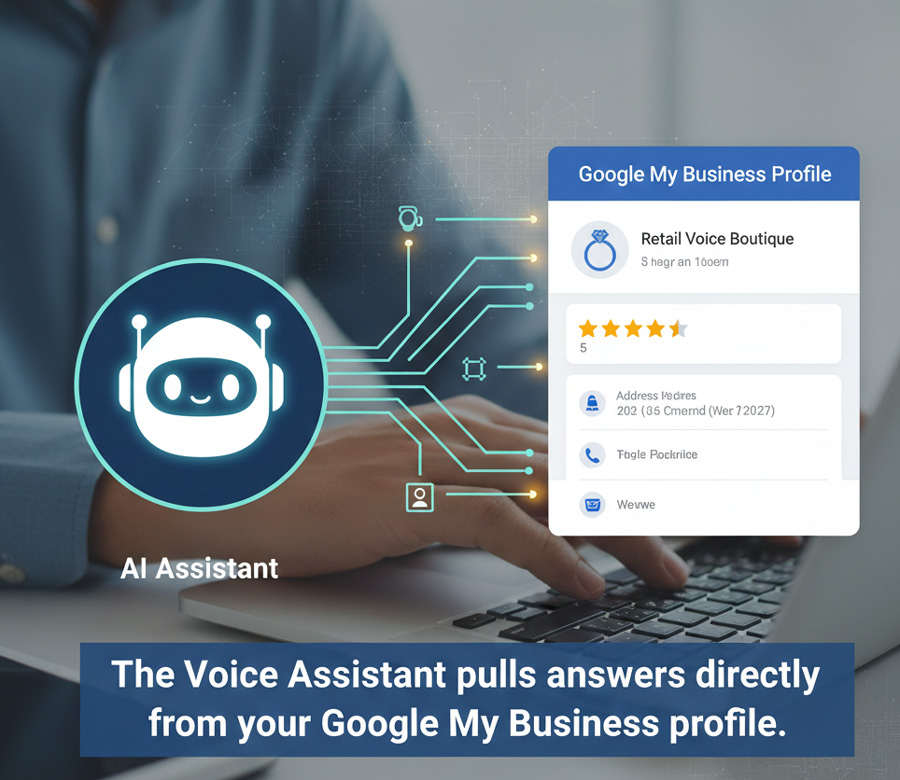
To rank for these voice searches, your Google Business Profile must be perfectly optimised.
What You Must Have in Place:
- accurate business name
- verified address
- updated hours
- real photos of collections
- product categories (bridal gowns, mother of the bride apparel, satin nightgowns
- WhatsApp click-to-chat
- regular GMB posts
The Voice Assistant pulls answers directly from your Google My Business profile.
GMB in Action:
Focus: Location
- Question: The Best Bridal Collection in Stellenbosch
- You describe: We are proud to be the best bridal necklace showroom in Stellenbosch. Whether you are the bride or looking for a bridesmaid wholesale store, our local showroom has everything you need for your special day.
- Button: Get Directions
If your profile is strong, you will appear first.
- Use Conversational Keywords on Your Website
Jewellery and apparel SEO is no longer just “diamond shop Stellenbosch” or “bridal store wholesale.”
Examples:
- “Where can I buy bridal jewellery in Stellenbosch?”
- “Which store has the latest natural cotton designs?”
- “Who sells affordable premium cashmere?”
- “Where can I buy real silver jewellery locally?”
Your website content, social media, blogposts must include natural, question-based keywords.
You use these conversational phrases to:
- homepage
- FAQs
- product category pages
- blog posts
- service pages
This will help Google map your content to real voice queries.

- Add an FAQ Section (Voice Search Loves This)
Voice search answers come from FAQ-style content.
Make FAQs for:
- jewellery guidance
- fabric and apparel questions
- store policies
- product types
- pricing logic
- quality and certification
Jewellery FAQ examples:
- “How to check gold purity?”
- “What is the difference between VVS and SI diamonds?”
- “Do you offer custom jewellery designs?”
Apparel FAQ examples:
-
- “What size options do you offer?”
- “Do you have plus-size winter ensembles?”
- “What fabric is best for daily wear?”
FAQ schema combined with clear answers = higher voice search visibility.

-
-
- Use Structured Data (Schema) to Help AI Understand Your Store
-
Voice assistants rely heavily on structured data.
Add:
-
- Local business schema
- Product schema
- FAQ schema
- Review schema
- Opening hours schema
This helps AI assistants answer:
-
- “Is this store open now?”
- “What collections do they offer?”
- “Do they have ratings above 4 stars?”
The better your structure → the better the voice answers → the more footfall.

-
-
- Improve Local Reviews (Voice Search Reads Sentiment)
-
When someone asks: “Which jewellery store is trusted in this area?”
Google will check:
-
- review quantity ( how many, how often)
- review quality (star ratings)
- Keywords inside reviews
Encourage customers to mention:
-
- product type (“diamond ring,” “bridal necklace,” “silk camisole”)
- location (“Stellenbosch”, “centre of town” “on the waterfront”)
- experience (“good service,” “trusted store”)
Voice search uses emotional tone and language patterns from your reviews to rank you.
-
-
- Make Your Website Load Fast — Especially on Mobile
-
- Most voice searches happen on mobile. If your site loads slowly, you lose the customer instantly.
Improve: - mobile design
-
- speed
- image compression (photos must open fast)
- clean navigation (easy movability on your site)
- click-to-call buttons (ease with which they can respond to your info)
Voice search is about convenience. Your website should feel effortless.
-
-
- Use Short Videos to Match Voice Search Intent
-
Many voice queries trigger mixed results — websites + videos.
Create short, clear videos for:
- jewellery close-ups
- diamond clarity explanations
- matching jewellery with hairpieces previews
- garment trial clips
- new arrivals walkthrough
Upload them to:
- YouTube
- Google Business Profile
Google often suggests these videos as answers to customers’ questions.
-
- Create Content That Solves Real Buyer Problems
Voice search isn’t for browsing—it’s for answers.
You must therefore create content that answers:
-
- how to choose the right jewellery for an occasion
- how to pick the right fabric for comfort
- how to judge gemstone quality
- how to match shoes and dress combinations
- which outfits suit certain body types
The more helpful your content, the more trust you build with Google.
Final Takeaway: Voice Search Is the New Front Door to Your Store

Jewellery and apparel aren’t just about products; they’re about how we feel and who we trust. Voice search is simply the newest way that trust is built.
People are already talking. They ask before they browse. The only question is: Is your brand listening with the right content, structure, local signals, and reviews?
Customers want clarity, convenience, and a brand they can talk to.
Give them all three through the right content and local signals, and honest reviews, and you’ll win more walk-ins, more calls, more WhatsApp leads, and more loyal customers.
Optimising for voice isn’t just a tech upgrade. It’s a commitment to being there exactly when your customer asks.
Start today, and you won’t just keep up—you’ll lead the conversation.
Ready to take your online business presence to new heights? Let us empower your store with the transformative potential of voice search optimisation and help you achieve exceptional results.